Riverine Bangladesh in Crisis: Environmental Degradation, Governance Failures, and Pathways toward Sustainable River Restoration
Bangladesh is one of the most river-dependent countries in the world, shaped by the complex hydrological interactions of the Ganges–Brahmaputra–Meghna (GBM) basin system. Rivers have historically influenced the country’s agriculture, economy, biodiversity, transportation, culture, and urban development. However, rapid industrialization, uncontrolled urbanization, river encroachment, water pollution, sedimentation, and transboundary water conflicts have severely degraded the ecological health of Bangladesh’s rivers. Major rivers surrounding urban centers, particularly the Buriganga, Turag, Shitalakkhya, and Karnaphuli, are experiencing alarming levels of pollution caused by industrial discharge, municipal waste, and heavy metal contamination.
This article critically examines the environmental degradation of Bangladesh’s river systems and evaluates the governance challenges associated with river management. Using the Buriganga River as a representative case study, the paper explores the scientific, institutional, ecological, and socioeconomic dimensions of river degradation. The study further analyzes the impacts of climate change, weak environmental regulation, and unsustainable development policies on river ecosystems. Drawing on international experiences and environmental governance frameworks, the paper proposes policy recommendations such as basin-wide integrated water management, enforcement of the Polluter Pays Principle, technological monitoring systems, and participatory river governance.
The study argues that restoring Bangladesh’s rivers is not merely an environmental priority but also a national imperative for ensuring food security, climate resilience, ecological sustainability, and long-term socioeconomic stability.
Bangladesh is globally recognized as a riverine country due to its dense network of rivers and floodplains. Located at the downstream end of the Ganges–Brahmaputra–Meghna (GBM) basin, the country possesses one of the largest deltaic systems in the world. Approximately 700 rivers, tributaries, and distributaries flow across Bangladesh, contributing significantly to its geography, ecology, economy, and cultural identity (BWDB, 2020). Rivers have historically served as the foundation of civilization in Bengal, facilitating trade, agriculture, transportation, fisheries, and human settlement for centuries.
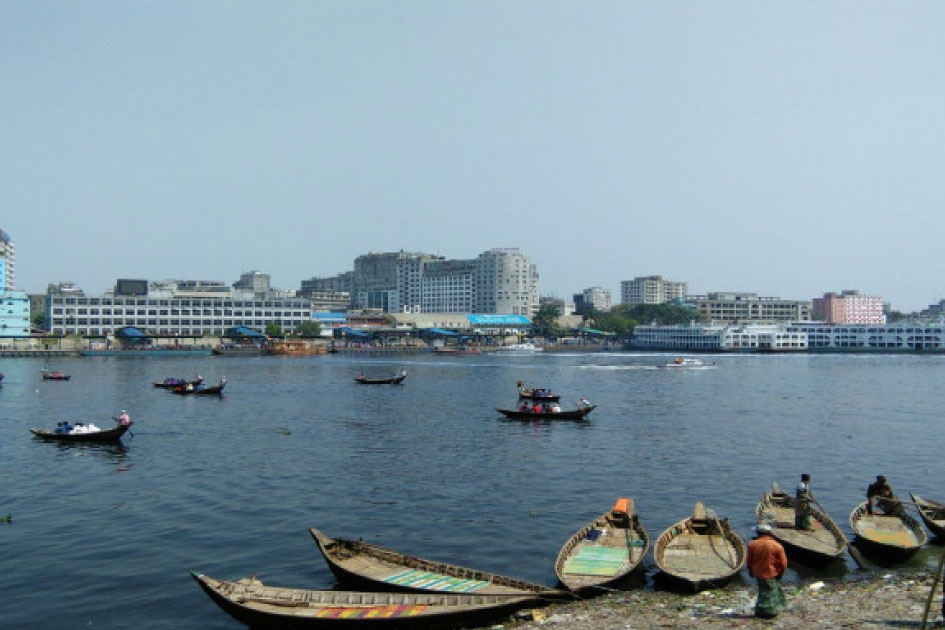
The relationship between the people of Bangladesh and rivers is deeply embedded in history and culture. Rivers have inspired literature, folk traditions, songs, livelihoods, and local economies. In 1972, shortly after the independence of Bangladesh, National Geographic Magazine published a cover story titled “Bangladesh: Hope Nourishes a New Nation.” The article portrayed the beauty and vitality of Bangladesh’s waterways through the iconic photography of Dick Durrance. Images of colorful boats sailing through the winding Turag River symbolized the ecological richness and cultural vibrancy of riverine Bangladesh.
However, the environmental condition of the country’s rivers has dramatically deteriorated over the last five decades. Unplanned urbanization, industrial pollution, illegal encroachment, over-extraction of natural resources, and weak governance structures have transformed many rivers into highly polluted and ecologically degraded systems. Rivers that once sustained life and prosperity are now struggling for survival.
Environmental degradation in Bangladesh’s river systems has emerged as one of the most critical sustainability challenges in South Asia. Scientific studies have identified alarming levels of heavy metal contamination, dissolved oxygen depletion, and ecologic